Valerian
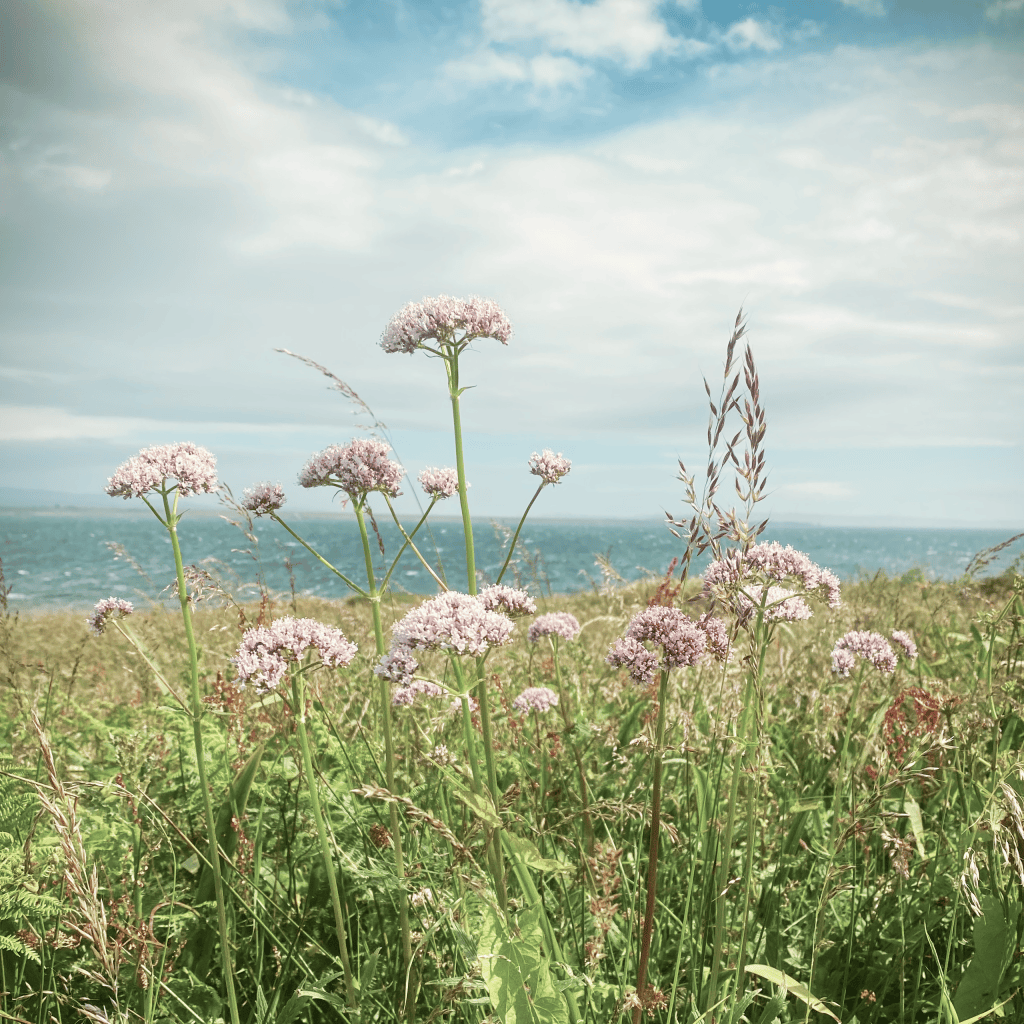
Humid, heavy and hazy. A blanket of stratus cloud covered the sky this midsummer here on Islay. Still, the land teaming with life held a steadfast radiance even beneath the grey skies.
I didn’t rise with the sun this solstice, rather I woke at my usual (early) time refreshed and giddy with the energy in the air. Opening the blinds; I paid heed to the world, letting the clouded light pour over me. Taking a minute to listen to the birdsong and soft lap of the waves against the shore. Bliss
Today the world felt still, inviting and timeless. Gone was the frantic energy that seemed to be merciless this Gemini season and instead a soft, gentle, receptive mist seemed to hang across the land. I brewed my coffee, lit some incense, gave thanks and stretched slowly – feeling this deep peace permeate my bones.
Getting dressed I drew on my eyeliner in shades of gold, wearing warm colours that reflected the glow of the (hidden) sun and put my things together. I headed out, bikini in bag alongside a towel, set of gardening shears and a couple of empty glass bottles to recycle. Today’s adventure was collecting herbs, recycling and getting a good dook in the sea.
As I set off along the coastal path, brushing past the dog roses, sweetness filled the air and I couldn’t help but smile.
Enough about me, In this post I want to introduce you to Valerian – one of my favourite wild flowers and plant allies…
Heady, sweet and stark – Valerian is around 1m tall, flowers at midsummer and has umbrels of lilac pink flowers facing to the sky. She appears almost out of nowhere but once in bloom is unmistakably noticeable.
Pungent would be the best way to put it. There’s no denying the potency of valerian. Cats often flock to her and her scent was rumoured to dispel miasma, bad spirits and even trolls in some mythologies!
In herbal practice Valerian is commonly used as a sleep remedy, her roots especially.
In humans valerian has a sedative effect, she’s a nervine (plant used to treat dis-ease of the nervous system) and antispasmodic. During and after the second world war Valerian was even used to help treat soldiers with post traumatic stress disorder.
As a sleep remedy, valerian carries us off into the realm of dreams, her flowers – five pointed and starlike serenading us into a gentler, receptive imaginative plain. The shape of the plant herself stretching up from the earth with hollow stems terminating into wide umbrels facing the heavens, as though channeling the skies downwards. It’s hardly surprising then that we associate valerian with the moon.
Channeling Valerian into our hearts:
I’ve spoken about the medicinal uses of Valerian but what about the energetic architecture of Valerian?
I associate Valerian with the sign of Cancer – primarily due to the timing of her blooms upon the summer solstice, when we begin our wade into the first water sign of the Zodiac. There is also a heavy Mercury (communicative) influence here which I will explain in a minute.
In Astrology the sign of Cancer is related to the fourth house, the deepest area of our chart – relating to family, home and our subconscious. Our roots so to speak.
Cancer is a yin (feminine/negative) sign, being receptive as opposed to assertive.
Key words are empathetic, caring, sensitive, dreamy and protective. Cancer is associated with the ‘great mother’ archetype.
We can use the imagery of the moon as a starting point in understanding the energetics of both the sign of Cancer and Valerian.
When we envision the moon, most see a full moon – casting her silvery light across the land. Some see a crescent moon distinct against an inky sky.
What both have in common is light. We associate the moon with luminosity, when in reality, our moon has no light of her own. She is reliant upon the sun to become visible to us. Only at new moon when she forms a conjunction with the sun does she entirely disappear from view… and yet we see and feel the invisible effect of the moon in our daily lives. The tides rise and fall, weather patterns differ as well as changes in human and animal behaviour.
The moon is, by nature, reflective. She is our emotional body – when we cultivate light into our lives we become luminous. Life is phasal and darkness is inevitable. However we would never cease to rise from invisibility and dullness if it weren’t for the radiance of our environment, friendships and experiences. To nurture our inner moon we must begin with the conception of our inner sun.
See article -St. Johns Wort and the inner light
When we slip from day into night and enter the world of dreams, in our slumber our emotional self continues to glow. As the moon reflects the sunlight our inner moon casts light in our subconscious. Here, we consolidate our emotions from the day within ourselves without being fully aware of the process. Our positive and negative experiences are remembered by our bodies.
Actually, it is well-known that REM sleep plays a pivotal role in the processing of salient and emotional waking-life experiences, strongly contributing to the emotional memory consolidation. In this vein, we highlighted that, to some extent, neuroimaging studies showed that the processes that regulate dreaming and emotional salience in sleep mentation share similar neural substrates of those controlling emotions during wakefulness. SRC:https://pmc.ncbi.nlm.nih.gov/articles/PMC6428732/
For this to happen we must be asleep. This is where the sedative and archetypal effect of Valerian comes into play in our evolutionary process.
On a physical level valerian lowers us gently into the sleep state. Studies have proven that she delays and softens entry into REM sleep. She plots a smoother voyage, navigating the shallower pools of dreamspace before submerging us deep into the trenches of unconsciousness.
Allowing us to begin the process of restoring our emotional body. Essentially mediating the conversation between the waking phase and sleeping phase.
See: The Governance of Mercury ☿ as communicator in this plant

